
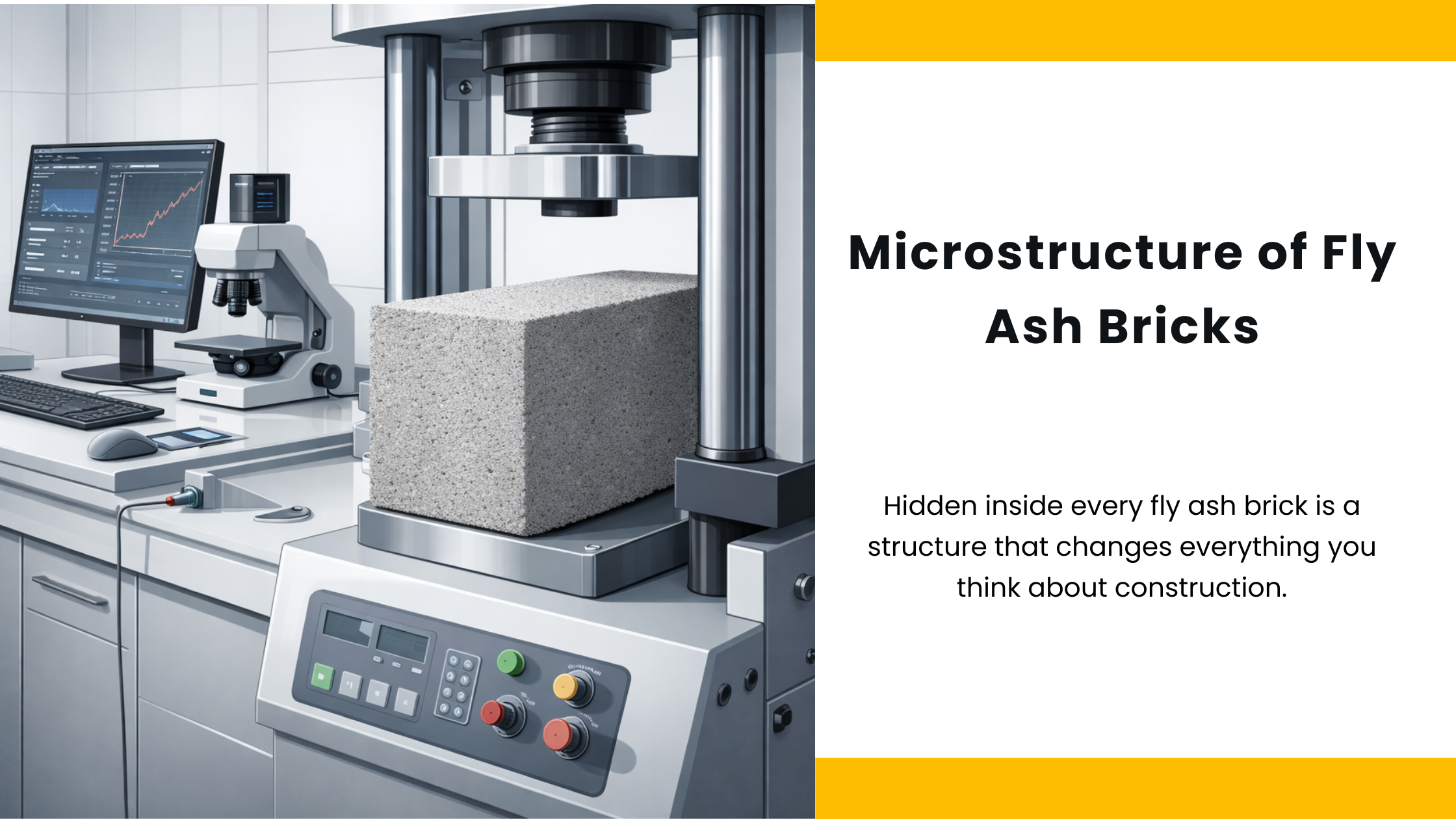
Advanced Analysis of Fly Ash Brick Structure
Electron Microscopy Analysis for Modern Sustainable Construction
By Raj Mineral – Leading Construction Material Innovators
The construction industry is witnessing a paradigm shift toward sustainable building materials, and the microstructure of fly ash bricks is at the forefront of this revolution. As environmental concerns mount and natural resources deplete, fly ash bricks have emerged as an eco-friendly alternative that doesn’t compromise on quality or durability.
Eco-Friendly Innovation
Transforms power plant byproducts into high-performance building materials, reducing waste and environmental impact.
Advanced Analysis
Electron microscopy reveals microstructural properties invisible to traditional testing methods.
Superior Durability
Exceptional resistance to chemical attack, weathering, and moisture penetration for long-lasting structures.
Quality Assured
Rigorous testing and electron microscopy analysis ensure consistent quality and compliance with international standards.
Understanding Fly Ash Bricks: A Sustainable Construction Solution
Fly ash bricks are manufactured from fly ash—a byproduct of thermal power plants—combined with lime and other binding materials. These bricks represent a significant breakthrough in sustainable construction, transforming industrial waste into high-performance building materials. The microstructure of fly ash bricks determines their mechanical properties, durability, and long-term performance, making detailed analysis crucial for quality assurance and structural reliability.
Unlike traditional clay bricks, fly ash brick microstructure benefits from the pozzolanic properties of fly ash, which enhance the material’s strength and durability over time. The careful composition and manufacturing process create a dense, uniform structure that outperforms conventional bricks in many applications.
The Role of Electron Microscopy in Analyzing Fly Ash Brick Structure
What is Electron Microscopy Analysis?
Electron microscopy analysis represents a sophisticated technique for examining the microstructure of fly ash bricks at incredibly high magnifications—often revealing details invisible to conventional optical microscopes. This advanced imaging technology provides unprecedented insights into the internal composition, pore structure, and particle arrangement within the material.
There are two primary types of electron microscopy used in construction material analysis:
- Scanning Electron Microscopy (SEM): Provides detailed surface and cross-sectional views of fly ash brick microstructure
- Transmission Electron Microscopy (TEM): Enables analysis of internal crystal structures and mineral phases
Why Electron Microscopy Analysis Matters for Fly Ash Bricks
The electron microscopy analysis of fly ash bricks reveals critical information about:
- Pore distribution and size affect water absorption and durability
- Particle bonding and interfacial zones determining mechanical strength
- Phase composition validating the pozzolanic reaction
- Crack propagation patterns predicting long-term structural performance
- Degree of hydration ensuring material maturity
Detailed Microstructural Characteristics of Fly Ash Bricks
1
Pore Structure and Density
One of the most significant findings from electron microscopy analysis is the superior pore structure of fly ash bricks compared to traditional clay bricks. The microstructure exhibits refined pore size distribution with predominantly small, well-distributed pores, lower total porosity leading to improved durability and reduced water absorption, and enhanced compactness throughout the brick matrix, contributing to superior strength.
These characteristics directly result from the pozzolanic reaction between fly ash particles and calcium hydroxide, creating a denser, more homogeneous fly ash brick microstructure over time.
2
Particle Morphology and Distribution
Electron microscopy analysis reveals that fly ash particles within the brick demonstrate irregular spherical morphology from the original fly ash particles, uniform distribution throughout the binding matrix, strong interfacial bonds between fly ash particles and the cement/lime matrix, and minimal void spaces indicating effective particle packing.
This exceptional particle arrangement contributes significantly to the mechanical properties and durability of fly ash bricks in high-rise construction and other demanding applications.
3
Hydration Products and Phase Composition
Advanced electron microscopy analysis identifies the hydration products within fly ash brick microstructure, including Calcium Silicate Hydrate (C-S-H) gel – the primary strength-contributing phase, Calcium Hydroxide (CH) crystals – evidence of ongoing pozzolanic reactions, Unreacted fly ash particles – demonstrating the gradual strength development, and Secondary minerals – formed through long-term curing processes.
The presence of well-developed C-S-H gel throughout the microstructure of fly ash bricks explains their excellent long-term strength gain and durability characteristics.
Advantages Revealed Through Electron Microscopy Analysis
🛡️ Superior Durability Properties
Electron microscopy analysis confirms that the microstructure of fly ash bricks provides exceptional resistance to chemical attack from sulfates and chlorides, weathering and freeze-thaw cycles, moisture penetration due to refined pore structure, and efflorescence minimized by the stable phase composition.
⚡ Enhanced Mechanical Performance
The detailed examination of fly ash brick microstructure through electron microscopy analysis demonstrates higher compressive strength development over time, improved tensile strength due to strong interfacial bonds, better crack resistance from uniform internal structure, and lower shrinkage compared to conventional bricks.
🌍 Sustainability and Environmental Benefits
Beyond structural advantages, electron microscopy analysis validates the environmental credentials of fly ash bricks through waste material utilization, reducing landfill burden, lower carbon footprint compared to clay brick manufacturing, energy efficiency in production processes, and long service life, minimizing replacement and waste.
Applications of Fly Ash Bricks in Modern Construction
🏢 High-Rise Building Construction
The superior properties revealed by electron microscopy analysis make fly ash bricks ideal for load-bearing walls in multi-story buildings, structural applications requiring consistent quality, seismic-resistant construction, and long-span structural elements.
🏗️ Specialized Construction Projects
Fly ash brick microstructure analysis has validated its use in coastal construction (excellent salt resistance), industrial facilities (chemical resistance), infrastructure projects (durability under stress), and green building certifications (LEED compliance).
🔍 Quality Assurance Through Electron Microscopy Analysis
Modern manufacturers utilize electron microscopy analysis as a quality control tool to ensure consistency of microstructure batch to batch, optimal hydration development before delivery, compliance with specifications for specific applications, and detection of defects before materials reach construction sites. This rigorous analysis ensures that every fly ash brick meets the stringent requirements of contemporary construction standards.
🚀 The Future of Fly Ash Brick Technology
As electron microscopy technology advances, researchers continue to uncover new insights into fly ash brick microstructure. Future developments include AI-powered microscopy analysis for real-time quality monitoring, enhanced fly ash processing improving pozzolanic reactivity, hybrid brick compositions combining multiple waste materials, and smart bricks with embedded sensors monitoring structural health.
Final Insights
The microstructure of fly ash bricks represents a triumph of modern materials science, combining sustainability with superior performance. Through electron microscopy analysis, scientists and engineers have proven that these innovative bricks not only solve environmental challenges but also deliver exceptional durability, strength, and reliability for modern construction projects. As urbanization accelerates and environmental consciousness grows, fly ash bricks validated by rigorous electron microscopy analysis stand as a testament to the construction industry’s commitment to sustainable, high-performance building materials.
Whether you’re designing a high-rise building, planning an infrastructure project, or committed to green construction practices, understanding the microstructure of fly ash bricks and the evidence provided by electron microscopy analysis makes a compelling case for this revolutionary building material.
Frequently Asked Questions
1. What is fly ash, and why is it used in brick manufacturing?
+
Fly ash is a fine powder byproduct collected from coal-fired power plant emissions. It’s used in brick manufacturing because of its pozzolanic properties—when combined with lime or cement, it undergoes a chemical reaction that creates durable cementing compounds. This transforms industrial waste into a valuable building material while reducing landfill burden.
2. How does electron microscopy analysis differ from traditional testing methods?
+
Electron microscopy analysis provides magnifications up to 100,000x, revealing internal microstructure invisible to optical microscopes. While traditional tests measure overall properties like strength and water absorption, electron microscopy shows why these properties exist by examining pore structure, particle bonding, and crystal formation in detail.
3. What are the key microstructural features that make fly ash bricks superior?
+
The primary advantages visible through electron microscopy analysis include: refined pore distribution (smaller, better-distributed pores), strong interfacial bonds between particles, well-developed C-S-H gel phases, and uniform particle distribution. These features combine to provide superior durability, strength, and longevity compared to traditional clay bricks.
4. Are fly ash bricks suitable for load-bearing applications in high-rise construction?
+
Absolutely. Electron microscopy analysis confirms that the microstructure of fly ash bricks provides excellent compressive and tensile strength properties suitable for load-bearing walls in multi-story buildings. Many modern high-rise projects successfully utilize fly ash bricks for structural applications, often exceeding performance requirements.
5. How does the pozzolanic reaction improve fly ash brick durability over time?
+
The pozzolanic reaction in fly ash brick microstructure is a long-term process where fly ash particles react with calcium hydroxide to form additional C-S-H gel. This continuous process, visible through electron microscopy analysis, means strength and durability actually improve with time—a property called “late strength gain” that distinguishes fly ash bricks from conventional materials.
6. What quality assurance standards ensure reliable fly ash brick microstructure?
+
Modern fly ash brick manufacturers employ electron microscopy analysis alongside traditional testing (compressive strength, water absorption, efflorescence) to ensure consistent microstructure. Quality standards like IS 12894 (India), ASTM C330 (USA), and EN 771-4 (Europe) establish specifications that manufacturers verify through rigorous microstructural analysis and testing protocols.
Ready to Build with Excellence?
Transform your construction projects with premium-quality fly ash bricks verified through advanced electron microscopy analysis. Partner with Raj Mineral for superior durability, sustainability, and performance.
Raj Mineral
Leading M Sand & Construction Materials Supplier in Udaipur, Rajasthan
📞 Phone
+91 9414169137 | +91 9799496137
jaimaheshindustries@yahoo.in
📍 50, Gayatri Sadan, Ekling Colony Sec. No. -3, Hiran Magri, Udaipur – 313002, Rajasthan, India
Village Bansliya, Near Iswal, Badgaon Dist. Udaipur-313002, Rajasthan, India
🏆 Building a Sustainable Future, One Brick at a Time
Raj Mineral – Your Trusted Partner in High-Performance, Eco-Friendly Construction Materials
Excellence | Reliability | Sustainability | Innovation