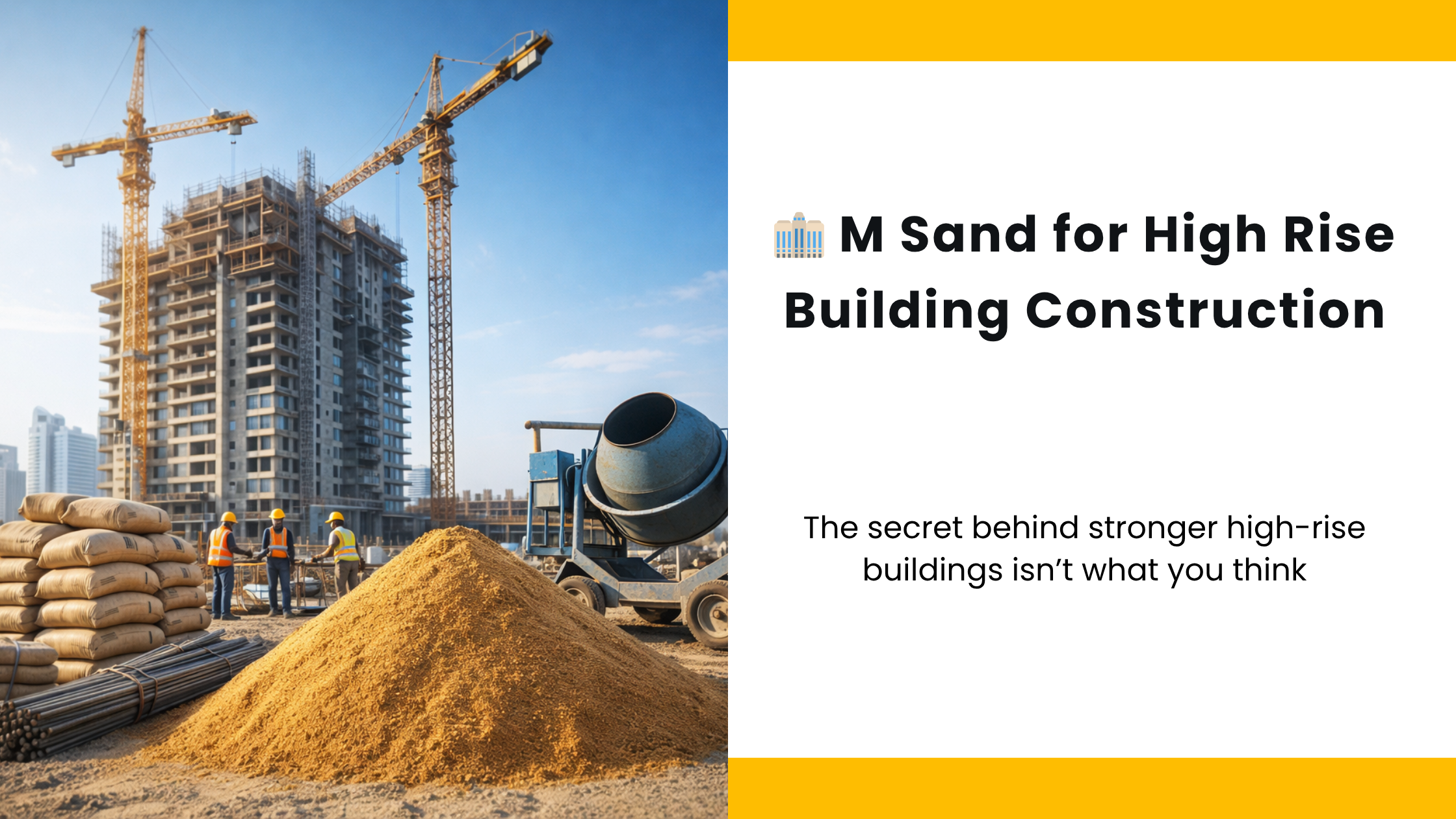
M-Sand: The Smart Choice for High-Rise Construction
The Future of Sustainable & Durable Construction Materials
📌 Introduction: M-Sand for High-Rise Buildings
The use of manufactured sand (M-sand) for high-rise building construction has catalyzed a revolutionary transformation in the construction industry. As urbanization accelerates and natural sand reserves dwindle, M-sand has emerged as the indispensable alternative for constructing towering structures with enhanced durability and superior performance. This comprehensive guide explores how manufactured sand in high-rise construction is fundamentally reshaping modern construction methodologies, architectural design, and engineering practices for today’s urban landscape.
🔍 What is M-Sand? Understanding Manufactured Sand
Definition and Composition of M-Sand
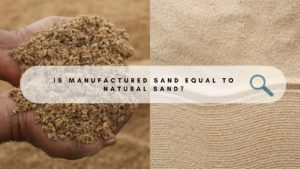
M-sand (Manufactured Sand) is artificially produced sand created by crushing granite rocks and other mineral aggregates to specific particle sizes. Unlike natural river sand, manufactured sand for construction is engineered to meet strict quality standards and specifications. The crushed sand particles have angular shapes, which provide superior binding properties compared to naturally weathered sand.
⚙️ How M-Sand is Produced
The production of M-sand in construction projects involves three essential stages:
💪 Why M-Sand is Essential for High-Rise Building Construction
Superior Strength & Durability
The angular particles of M-sand for high-rise buildings interlock more effectively, creating stronger concrete bonds. This characteristic is crucial for constructing buildings with enhanced structural performance.
🌱 Sustainable Alternative
M-sand as an eco-friendly solution reduces environmental damage while meeting the growing demands of modern construction projects. It protects river ecosystems and reduces ecological imbalance.
⭐ Advantages of M-Sand in High-Rise Construction
🔨 Enhanced Concrete Compressive Strength
Studies demonstrate that concrete made with manufactured sand achieves 20-40% higher strength compared to natural sand. This ensures safer, more durable structures with less maintenance.
💧 Improved Water Resistance
The particle gradation creates a denser concrete matrix, significantly improving water resistance. This extends the building’s lifespan and reduces costly repairs.
🎯 Better Workability & Consistency
Consistent particle size distribution ensures uniform concrete mixing and application, eliminating variations that occur with natural sand.
💰 Cost Efficiency
Manufactured sand is more economical than natural alternatives, especially for massive construction projects requiring thousands of tons of aggregates.
✨ Reduced Segregation & Bleeding
High-performance concrete with M-sand exhibits minimal segregation and bleeding issues, resulting in superior concrete quality and faster setting times.
🌍 Environmental Protection
Eliminates destructive river mining operations, protecting aquatic ecosystems and conserving groundwater resources.
⚖️ M-Sand vs Natural Sand: A Detailed Comparison
| Aspect | M-Sand | Natural Sand |
|---|---|---|
| Source | Manufactured from rocks | River beds and quarries |
| Particle Shape | Angular & uniform | Rounded & irregular |
| Compressive Strength | Higher (20-40% more) | Lower |
| Water Content | Minimal (0-1%) | Variable (2-5%) |
| Durability | Superior | Moderate |
| Environmental Impact | Sustainable ✓ | Depletes ecosystems ✗ |
| Cost | Economical | Variable & rising |
| Consistency | Highly consistent | Inconsistent |
✅ Quality Standards and Specifications for M-Sand
IS 383:2016 Compliance
M-sand for construction must comply with Indian Standard IS 383:2016, which specifies:
Between 2.5 to 3.0
Maximum 5%
Not more than 30%
Well-graded particles
🧪 Testing and Quality Assurance
Before using M-sand in high-rise construction projects, comprehensive testing ensures:
- ✓ Sieve analysis for particle gradation
- ✓ Compressive strength tests on concrete samples
- ✓ Water absorption tests
- ✓ Soundness and durability tests
- ✓ Chemical composition analysis
🎯 How M-Sand Improves Building Performance
🏗️ Enhanced Structural Integrity
Buildings constructed with M-sand for structural applications demonstrate superior load-bearing capacity and stability. The engineered sand properties create stronger bonds between cement and aggregates.
⚡ Reduced Construction Time
The consistency and workability of M-sand in construction accelerate the concrete curing process. Fast-setting concrete allows construction teams to maintain aggressive project schedules.
🛡️ Longevity and Reduced Maintenance
High-rise buildings constructed with M-sand require significantly less maintenance. The improved durability reduces repair costs and extends the building’s lifespan to 50+ years.
🌍 Environmental and Sustainability Benefits
♻️ Eco-Friendly Construction Solutions
The adoption of sustainable M-sand addresses critical environmental challenges. By eliminating destructive river mining, manufactured sand benefits:
Protects aquatic habitats
Maintains soil fertility
Conserves water reserves
Protects wildlife habitats
🔨 M-Sand Applications in High-Rise Construction
Load-Bearing Structures
Pillars, beams, and slabs
Reinforced Concrete
RCC construction for durability
Foundation Work
Deep foundations and piles
Precast Elements
Prefabricated components
✨ Conclusion: The Future of M-Sand in Construction
M-sand for high-rise building construction represents the future of sustainable, durable, and cost-effective development. As cities expand vertically and environmental concerns intensify, manufactured sand solutions provide the optimal balance between performance, sustainability, and economy. By adopting M-sand in modern construction projects, builders ensure stronger structures, faster construction timelines, and reduced environmental impact.
❓ Frequently Asked Questions (FAQs)
📌 Is M-Sand as Strong as Natural Sand for High-Rise Buildings?
Yes, M-sand is significantly stronger than natural sand for high-rise construction. Studies show that concrete made with M-sand achieves 20-40% higher compressive strength compared to natural sand. The angular particle shape creates superior interlocking and bonding with cement, making it ideal for demanding high-rise applications. This enhanced strength ensures better structural integrity and load-bearing capacity for tall buildings.
💰 What is the Cost Difference Between M-Sand and Natural Sand?
M-sand is generally 15-25% more cost-effective than natural sand in most regions. While initial material costs may vary, manufactured sand reduces overall project costs through reduced transportation, eliminated mining permits, and faster construction timelines. For large-scale projects requiring thousands of tons of sand, the savings become substantial.
🔧 Can M-Sand Be Used for All Types of Construction Work?
Yes, M-sand can be used for virtually all construction applications. From load-bearing structures and RCC construction to finishing work and plaster, manufactured sand serves multiple purposes. For specific applications like concrete blocks, always verify compliance with relevant IS codes and project specifications before procurement.
🌍 How Does M-Sand Impact Environmental Sustainability?
M-sand significantly improves environmental sustainability by eliminating destructive river mining operations. The use of eco-friendly manufactured sand protects aquatic ecosystems, prevents soil erosion, and conserves groundwater resources. By choosing sustainable M-sand, construction projects reduce their environmental footprint while maintaining superior quality and durability.
✅ What Quality Standards Should M-Sand Meet?
M-sand must comply with IS 383:2016 standards for use in high-rise construction. Key specifications include:
- Fineness Modulus between 2.5-3.0
- Silt and clay content below 5%
- Proper particle size distribution
- Minimal deleterious substances
Always request certified test reports from suppliers, ensuring compliance.
⏱️ How Long Do Buildings Constructed with M-Sand Last?
Buildings constructed with M-sand demonstrate exceptional longevity, typically lasting 50+ years with minimal maintenance. The superior durability of concrete made with M-sand results in reduced degradation and lower repair costs. Many modern high-rise buildings using M-sand are designed to last 100+ years, ensuring long-term value for stakeholders.
🚀 Ready to Build with M-Sand?
Choose sustainable, durable, and cost-effective construction materials with Raj Mineral for your next project.