
When people plan a building—whether it’s a home, a commercial space, or an industrial structure—the first discussions usually revolve around design. Elevation styles, modern layouts, finishes, and visual appeal take centre stage. Design boards fill up with ideas, references, and inspiration images.
Yet, many well-designed buildings begin to show cracks, dampness, and surface damage far earlier than expected.
This leads to a common but uncomfortable question:
Why do structures with good design still age poorly?
The hidden truth is simple but often ignored—design cannot compensate for poor brick quality. While design shapes how a building looks, brick quality determines how long it stands strong. For truly long-lasting structures, what lies beneath the surface matters far more than what meets the eye.
Why Design Alone Cannot Guarantee Building Longevity
Design plays an important role in construction. It defines space planning, load paths, ventilation, and overall aesthetics. A well-thought-out design can improve functionality and comfort.
However, design has clear limitations when the materials used are weak.
A building is only as strong as its core components. Even the best architectural drawings cannot protect a structure if the bricks lack strength, consistency, or durability. Visual appeal and structural durability are two very different things.
Design works with materials—it does not replace their role. When bricks fail to perform under load, moisture, or weather stress, the design loses its effectiveness over time.
This gap between appearance and performance is where most long-term construction problems begin.
How Brick Quality Directly Affects Structural Strength
Bricks are not just wall fillers. They are load-bearing elements that work continuously throughout the building’s life. Their quality directly impacts overall structural behaviour.
Compressive Strength
Bricks must withstand vertical loads from floors, slabs, and roofs. Low compressive strength leads to gradual crushing or deformation, which eventually reflects as cracks in walls and plaster.
Brick Density and Uniformity
Dense, uniform bricks distribute loads evenly across the wall. Variations in density create weak spots, causing uneven stress and long-term instability.
Load Distribution
Good-quality bricks work together as a system. When brick strength is inconsistent, load transfer becomes irregular, increasing the risk of localized damage.
Bonding with Mortar
Bricks must bond properly with mortar to form a solid wall. Poor surface quality or incorrect absorption rates weaken this bond, reducing wall integrity.
Wall Stability Over Time
Strong bricks maintain shape and alignment over years. Weak bricks slowly shift, shrink, or crack, even if the structure initially looks sound.
This is why brick quality and building durability are inseparable.
Common Problems Caused by Low-Quality Bricks
Many site-level issues are wrongly blamed on workmanship or weather, when the root cause lies in brick quality.
Early Wall Cracks
Cracks appearing within a few years are often due to weak bricks failing under normal structural stress.
Dampness and Water Seepage
High water absorption allows moisture to enter walls, leading to damp patches, peeling paint, and mould growth.
High Maintenance and Repair Costs
Frequent plaster repairs, repainting, and waterproofing treatments increase long-term expenses significantly.
Plaster Failures
Uneven brick surfaces and poor bonding cause plaster to detach or crack prematurely.
Reduced Building Lifespan
Over time, these small failures combine to shorten the effective life of the structure, regardless of how good the original design was.
These problems appear quietly, often years after construction, making them costly and difficult to fix.
Why Brick Quality Matters More in Long-Term Construction
Construction decisions should be evaluated over decades, not just at completion.
A building may look impressive for the first two or three years, but true performance is revealed over 10–20 years. Poor bricks weaken silently, long before visible damage becomes serious.
The cost impact is also significant. Repairing cracks, dampness, and structural distress over time often costs far more than choosing better bricks at the beginning.
From a safety perspective, material degradation affects load-bearing capacity, especially in multi-storey or high-occupancy structures.
For long-lasting structures, investing attention in building material quality is not optional—it is essential.
What Makes a Brick “High Quality” in Practical Terms
For buyers and builders, quality should be judged by performance, not claims.
Consistent Size and Shape
Uniform bricks ensure straight walls, even load distribution, and better construction accuracy.
Strength Standards
Bricks should meet defined strength requirements suitable for structural use, ensuring reliability under load.
Low Water Absorption
Controlled absorption reduces dampness, improves mortar bonding, and enhances durability.
Weather Resistance
Quality bricks perform well across seasons—heat, rain, and humidity should not degrade them quickly.
Manufacturing Process and Quality Control
Factory-controlled production ensures consistency, reducing on-site surprises and variability.
Focusing on these factors helps buyers make informed decisions without getting lost in technical complexity.
Where Fly Ash Bricks Fit into Long-Lasting Construction
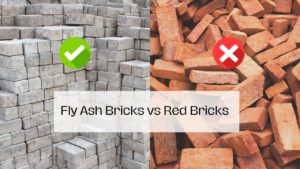
Fly ash bricks represent a more engineered approach to masonry materials. Unlike traditional site-dependent bricks, they are produced under controlled manufacturing conditions.
This results in:
- Uniform strength across batches
- Better bonding with mortar
- Lower water absorption
- Improved dimensional accuracy
- Reduced long-term maintenance
Because of these characteristics, many builders prefer fly ash bricks for construction where durability and consistency are priorities. When used correctly, such bricks support long-term structural stability rather than just short-term appearance.
Conclusion
Design attracts attention, but brick quality decides how long a building actually lasts. Cracks, dampness, and premature repairs are rarely design failures alone—they are often the result of compromised material choices made early in the project.
For homeowners, builders, and engineers focused on long-lasting structures, prioritising durable brick materials is one of the most important decisions in the entire construction process.
Choosing the right bricks at the beginning can quietly protect a structure for decades—and save years of repair costs later.
For construction projects where long-term strength, durability, and material consistency matter, choosing the right bricks is a critical decision. Fly ash bricks offer better structural performance, uniform quality, and reduced long-term maintenance compared to conventional options. Raj Mineral manufactures these bricks under controlled processes to support reliable and long-lasting construction requirements.
To learn more about specifications, availability, or suitability for your project, contact us for detailed information and assistance.