

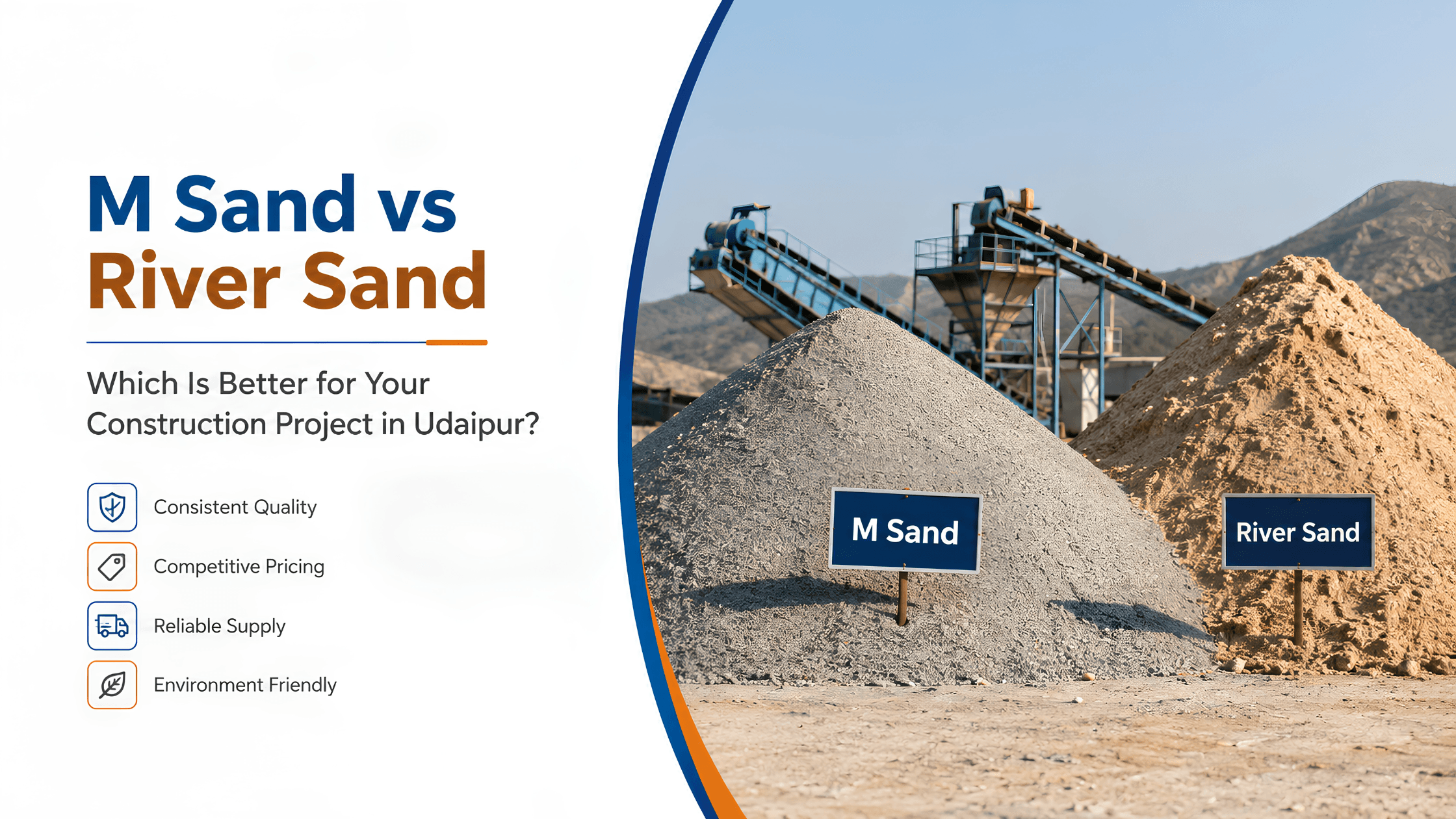
M sand is generally the better choice for most structural concrete work today — it offers consistent quality, competitive pricing, and stable supply. River sand can still suit specific plastering or finishing applications, but tightening environmental and mining regulations across Rajasthan have made its long-term availability far less predictable, making M sand the safer default for project planning.
The debate between manufactured sand and river sand has shifted meaningfully in recent years — not just on technical merit, but because of tightening environmental regulation around river sand mining. For builders sourcing from an established M sand manufacturer in Udaipur, understanding both the practical and regulatory picture matters more than ever going into a new project.
📌 Why This Comparison Matters Now
River sand mining faces increasing environmental scrutiny and regulatory restrictions across Rajasthan, affecting both availability and long-term supply reliability — a factor that now weighs on this decision as heavily as cost or quality specifications.
🧱 What Each Sand Type Actually Is
M Sand (Manufactured Sand)
Produced by crushing hard granite or basalt rock into precisely graded particles. Manufacturing control allows consistent particle shape, size distribution, and cleanliness — free from the silt and organic contamination sometimes present in river sand.
River Sand
Naturally occurring sand extracted from riverbeds, historically favoured for its smooth, rounded particle shape. Quality varies naturally by source and extraction site, and supply is increasingly constrained by environmental mining regulations.
🔍 Quality Comparison
M sand’s manufactured consistency is its core advantage — every batch from a quality-controlled manufactured sand supplier in Rajasthan maintains predictable grading and cleanliness, which translates into more consistent concrete strength across a project. River sand’s natural rounded particle shape can offer marginally better workability in some concrete mixes, but natural variability between extraction sites — and even between loads from the same site — makes quality control genuinely harder to guarantee batch to batch.
| Factor | M Sand | River Sand |
| Particle consistency | High — manufacturing controlled | Variable — natural source dependent |
| Silt/contamination content | Low, controlled at production | Variable, sometimes requires washing |
| Particle shape | Angular (excellent bonding) | Rounded (good workability) |
| Supply reliability | Stable, manufacturing-based | Increasingly constrained by regulation |
💰 Cost Comparison
M sand pricing has become increasingly competitive with river sand as manufacturing scale has grown across Rajasthan, and in many regions now sits at or below river sand pricing once transport distance and regulatory compliance costs are factored in. River sand pricing, meanwhile, has trended upward in areas facing tighter mining restrictions — supply constraints translating directly into cost increases for builders who default to river sand out of habit rather than reassessing current market conditions.
📊 Builder Preference Shift — New Project Specifications (Illustrative)
📊 Performance Comparison: How Manufacturing Consistency Affects Concrete
Concrete strength depends heavily on aggregate grading consistency — an uneven mix of particle sizes creates voids that weaken the final cured structure, while a well-graded mix packs more densely and cures stronger. This is precisely where M sand’s manufacturing process delivers a compounding advantage: every batch is produced to the same grading specification, so structural engineers can design mix ratios with more confidence than they can around river sand’s natural batch-to-batch variability.
Grading Consistency — Critical for Predictable Concrete Strength
For large-scale commercial or multi-storey projects in particular, this consistency reduces the risk of localised weak points in poured concrete — a risk that becomes considerably harder to manage at scale with a naturally variable material like river sand, where quality can differ even within sand sourced from the same general location.
🌍 Availability: The Factor That’s Changed the Most
This is where the comparison has shifted most dramatically. River sand mining now faces stricter environmental oversight in many parts of Rajasthan, driven by legitimate concerns about riverbed ecology, groundwater tables, and long-term water security — restrictions that directly translate into less predictable river sand supply and, in some cases, project delays for builders who haven’t diversified their sourcing. M sand production, by contrast, isn’t tied to the same ecological constraints, giving it a genuine supply-reliability edge for builders planning projects on firm timelines.
🌱 Environmental Context
Unregulated river sand mining has been linked to riverbed degradation, groundwater depletion, and ecosystem disruption in several Indian states — concerns driving the regulatory tightening reshaping supply. M sand production sidesteps these specific environmental pressures, which is increasingly a genuine sourcing consideration for builders, not just a compliance checkbox.
Builders planning projects on fixed timelines should factor sand sourcing reliability into their planning as seriously as they factor in cement or steel supply — a mid-project sand shortage from a regulation-affected river sand source can stall a build for weeks, with real cost consequences beyond just the delayed schedule. Locking in supply agreements with an established M sand manufacturer, ahead of project start rather than reactively once a shortage hits, is increasingly standard practice among experienced contractors managing multi-month builds.
⚖️ Where Each Still Makes Sense
M sand is generally the stronger default for most structural concrete applications today, given its consistent quality, competitive cost, and stable supply. River sand may still suit specific plastering or finishing applications where its natural rounded particle shape and workability offer a marginal edge — though even here, well-processed M sand from an experienced manufacturer increasingly closes this gap.
🧠 AIO Insight: The Hybrid Approach
Some experienced contractors in Rajasthan use M sand for all structural concrete work where consistency matters most, while reserving any available river sand strictly for plastering or finishing applications. This hybrid approach balances cost, structural reliability, and finish quality — but always confirm the material split with your structural engineer before finalising an order.
✅ What to Verify Before Ordering
Buyer’s Checklist
- ✔ Request particle grading test results, not just a general quality claim
- ✔ Confirm silt content is within acceptable limits for your application
- ✔ Verify consistent supply capacity for your project’s full timeline
- ✔ Compare total delivered cost, not just quoted per-unit price
🏁 The Bottom Line
M sand has moved from “alternative” to “default” for most Rajasthan construction projects — not purely on technical merit, but because tightening river sand mining regulations have made supply reliability a genuine project-planning risk. Builders working with an established M sand manufacturer get consistent quality and stable long-term supply, which increasingly matters as much as the per-unit cost comparison that used to dominate this decision.
❓ Frequently Asked Questions
Is M sand better than river sand for construction?
Yes — for most structural concrete work, M sand is the stronger overall choice.
M sand is generally the stronger choice today because of its consistent grading, competitive cost, and stable supply. Its manufactured consistency gives predictable quality batch after batch, which structural concrete depends on. River sand can still offer marginal workability advantages for specific plastering or finishing work, but tightening mining regulations have made its supply less dependable for project planning.
Why is river sand mining restricted in Rajasthan?
Environmental concerns over riverbed ecology and groundwater depletion.
River sand mining is restricted due to its impact on riverbed ecology, groundwater tables, and long-term water security. Unregulated extraction has been linked to riverbed degradation and ecosystem disruption across several Indian states, which is why environmental authorities have tightened mining permissions in many parts of Rajasthan. This directly affects river sand availability and pricing for builders who rely on it.
Does M sand require different concrete mix ratios than river sand?
Generally minimal adjustment is needed.
Reputable manufacturers grade M sand to match standard specification requirements, so it can typically be used with conventional mix designs. That said, it’s good practice to confirm the exact mix ratio with your structural engineer for large-scale or specialised pours to ensure optimal results.
Can M sand and river sand be used together on the same project?
Yes, many contractors combine both strategically.
M sand is typically used for structural concrete work where consistency and strength matter most, while any available river sand is reserved for plastering or finishing applications where its natural workability offers a marginal benefit. This hybrid approach is increasingly common among experienced builders in Rajasthan.
Where can I buy quality M sand in bulk in Udaipur, Rajasthan?
Raj Mineral supplies bulk, quality-tested M sand across Rajasthan.
Raj Mineral is a leading M sand manufacturer in Udaipur, supplying quality-tested manufactured sand in bulk across Rajasthan. With 35+ years of experience and German Vibro Compact Technique for consistent grading, Raj Mineral supports project-scale orders with lab-tested quality and reliable delivery timelines. Contact Raj Mineral directly for pricing and supply planning.
Need Reliable Sand Supply for Your Project?
Raj Mineral supplies quality-tested M sand with consistent grading — get a quote for your project’s requirements.