

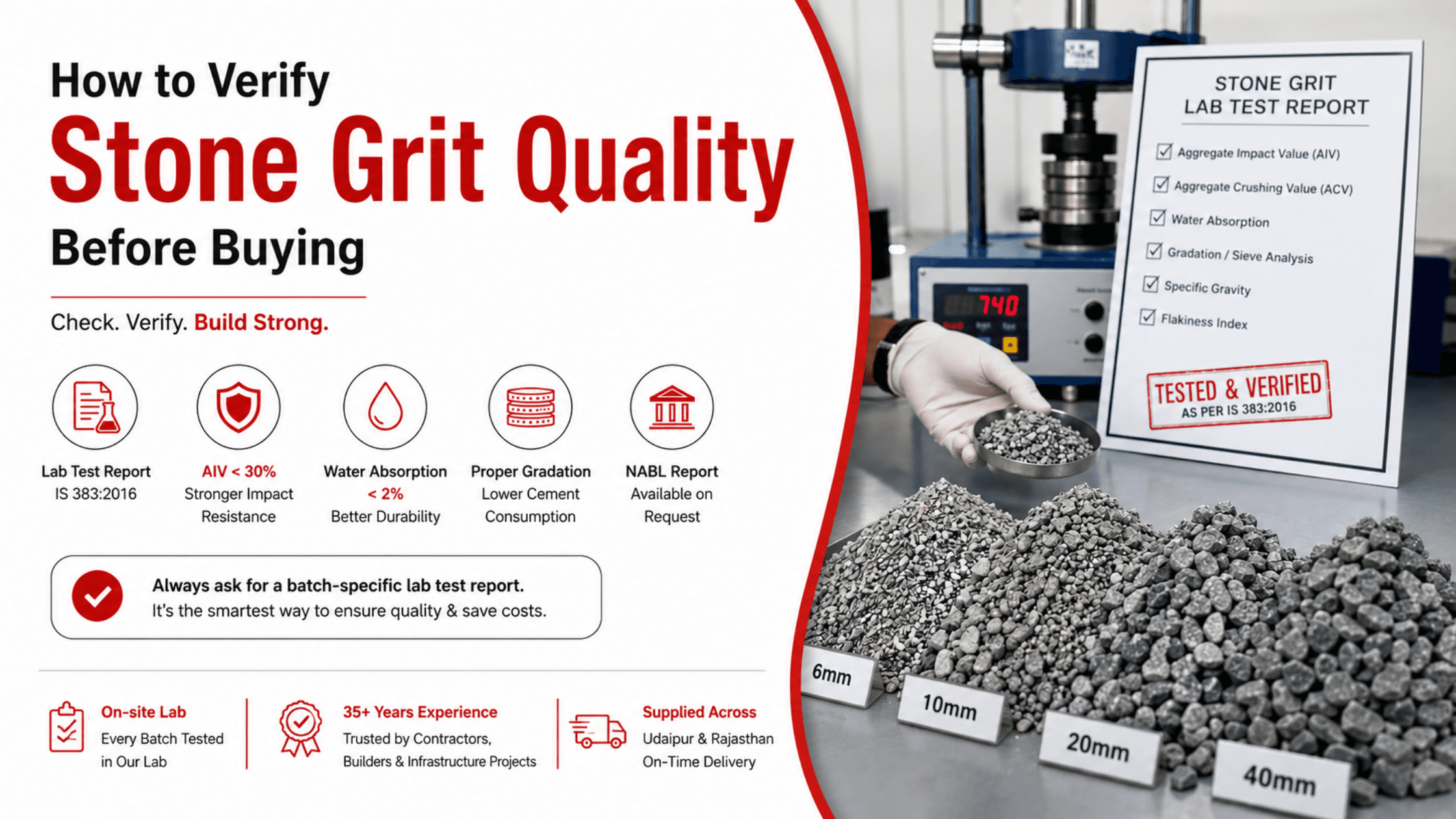
Before buying crushed stone grit, always ask the supplier for a lab test report showing aggregate impact value (AIV), crushing value (ACV), water absorption, and gradation as per IS 383:2016. Quality stone grit should have AIV below 30%, water absorption under 2%, and consistent particle size. Trusted manufacturers of crusher stone grit in Udaipur, like Raj Mineral, test every batch in an on-site lab — a genuine supplier will always share this report on request.
📋 Table of Contents
- Why a Stone Grit Lab Test Report Matters More Than Visual Inspection
- 5 Key Parameters to Check When You Verify Stone Grit Quality
- How to Read the Report Like a Pro
- What a Trusted Stone Grit Supplier in Rajasthan Does Differently
- Take-Away Tips
- FAQs
🔍 Why a Stone Grit Lab Test Report Matters More Than Visual Inspection
Most buyers judge stone grit quality by colour, size, or how it feels in hand. But grit that looks fine can still fail structurally.
Weak crusher stone grit reduces concrete bonding strength, increases water absorption in roads, and shortens a structure’s life. A proper stone grit lab test report removes this guesswork by giving you real, comparable numbers instead of a visual guess.
For contractors handling NHAI, PWD, or private residential projects across Udaipur and Rajasthan, this report is often required documentation anyway — so verifying it before, not after, a bulk purchase saves both cost and rework.
🧪 5 Key Parameters to Check When You Verify Stone Grit Quality
Aggregate Impact Value (AIV)
Measures resistance to sudden impact load. As per IS 383 stone grit testing norms, AIV should stay below 30% for structural concrete and road work.
⚠️ Higher values mean the stone crumbles under stress over time — a direct risk for load-bearing structures.
Aggregate Crushing Value (ACV)
Shows resistance to gradual crushing load — like the weight of a building or vehicle traffic. IS 383 recommends ACV under 30% for load-bearing use.
✅ Lower ACV = stronger stone. Raj Mineral’s tested grit clocks a crushing value of 17% — well within safe limits.
Water Absorption
Grit with water absorption above 2% can weaken concrete and cause cracking in Rajasthan’s extreme heat cycles. Quality-tested crusher stone grit in Udaipur typically absorbs only 0.4–1% moisture.
⚠️ Critical for Rajasthan’s climate — high absorption + heat cycling = cracked concrete within 2–3 years.
Gradation / Sieve Analysis
Shows particle size distribution. Uneven gradation creates more voids in concrete, requiring extra cement to fill gaps — directly raising your material cost per batch. Always verify gradation matches the grade you ordered (6mm, 10mm, 20mm, 40mm).
Specific Gravity & Flakiness Index
Specific gravity reflects stone density and strength; flakiness index reveals flat or elongated particles that weaken bonding. Both should be checked alongside your M Sand quality check if you’re sourcing multiple materials for the same project.
📄 How to Read the Report Like a Pro
Don’t just confirm numbers exist — check if they meet IS 383:2016 limits. Here’s what to look for beyond the raw figures:
🏛️ Lab Accreditation
Ask whether testing was done in-house or at a third-party NABL-accredited lab. For government and infrastructure projects, NABL backup is often mandatory.
📅 Report Date
Reports older than 3–6 months may not reflect current stock. Crusher plants source raw stone from different quarry batches over time — always ask for a fresh, batch-specific report.
📦 Batch Matching
Confirm the report matches the exact grade (10mm, 20mm etc.) you’re ordering. A 20mm report doesn’t guarantee 10mm quality from the same plant.
⚠️ Watch out: Some resellers share generic brochure-style reports rather than actual batch test data. A real lab report will have specific numeric results for each test parameter — not just tick marks or “pass” labels.
🏗️ What a Trusted Stone Grit Supplier in Rajasthan Does Differently
Established manufacturers with an on-site testing lab can share fresh, batch-specific reports instantly. This is the fastest way to separate a genuine crusher stone grit supplier in Udaipur from a reseller simply repackaging third-party stone.
If you’re also sourcing manufactured sand for the same project, ask for its gradation report too — consistency across materials directly affects overall concrete strength and workability.
| Check | Genuine Manufacturer | Reseller / Unverified |
|---|---|---|
| Lab Test Report | Batch-specific, fresh | Generic / dated |
| On-Site Lab | ✅ Yes | ❌ Usually No |
| IS 383:2016 Compliance | Verified per batch | Cannot confirm |
| Grade Accuracy | Screened & graded | Mixed / unscreened |
| NABL Report (on request) | Available | Not available |
Before You Place That Bulk Order — Do This
❓ Frequently Asked Questions
Q1. What is a good aggregate impact value (AIV) for crusher stone grit?
A good AIV for construction-grade crusher stone grit is below 30%, as per IS 383:2016. Lower values mean stronger resistance to impact and better durability in concrete and road use. For premium highway projects like NHAI work, many engineers prefer grit with AIV below 20% for extra structural confidence.
Q2. How do I verify if a stone grit lab test report is genuine?
Confirm which lab conducted the test — in-house or NABL-accredited third party — and check the testing date. A genuine stone grit supplier in Udaipur with an on-site lab can share a fresh, batch-specific report on request. Generic reports without specific numeric results or test dates are a red flag.
Q3. Why does water absorption matter in a stone grit quality check?
High water absorption (above 2%) weakens concrete bonding and raises crack risk in hot climates like Rajasthan. Quality-tested crusher stone grit typically shows 0.4–1% water absorption in lab reports — well within safe limits for concrete and road construction applications.
Q4. Does stone grit quality affect overall construction cost?
Yes. Poorly graded or high-absorption grit needs more cement to fill voids, raising material cost per batch. Verified, well-graded stone grit also reduces long-term maintenance costs since it produces stronger, more durable concrete structures that don’t require early repairs.
Q5. Where can I buy quality-tested crusher stone grit in Udaipur, Rajasthan?
Manufacturers with in-house testing labs and 35+ years of experience, such as Raj Mineral in Udaipur, test every batch for AIV, ACV, and gradation before dispatch. They supply crusher stone grit in 6mm, 10mm, 20mm, and 40mm grades to contractors, builders, and infrastructure projects across Rajasthan — making quality verification straightforward for bulk buyers.
📌 Key Takeaways
- ✓ Visual inspection alone cannot verify crusher stone grit quality — always demand a lab test report
- ✓ Check AIV and ACV against IS 383:2016 — both should be below 30%
- ✓ Water absorption above 2% is a red flag for Rajasthan’s heat-cycle climate
- ✓ Insist on batch-specific, dated reports — not generic brochures
- ✓ For government projects, always back up in-house reports with NABL-accredited lab results
- ✓ Verified grit reduces cement wastage, rework cost, and long-term maintenance expenses
Need Lab-Tested Stone Grit in Udaipur?
Get Batch-Specific Lab Reports With Every Order
Crusher Stone Grit in 6mm · 10mm · 20mm · 40mm — IS 383 tested, on-site lab verified, supplied across Udaipur & Rajasthan for 35+ years.