

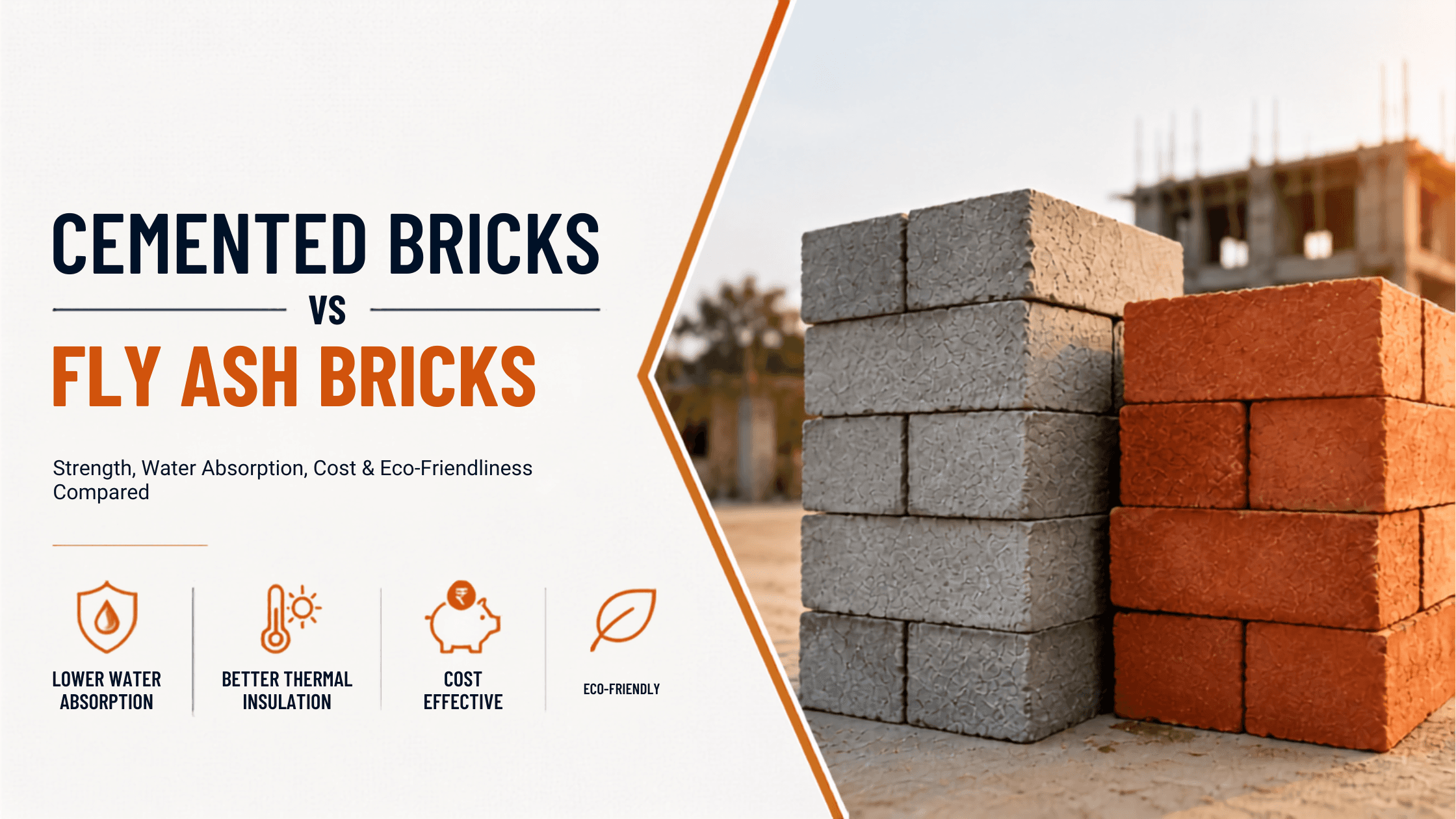
Cemented Solid Blocks and Fly Ash Bricks are both manufactured by Raj Mineral in Udaipur — and both are trusted choices for construction in Rajasthan. The right pick depends entirely on your project type: load-bearing structural walls call for Cemented Solid Blocks, while partition walls, exterior cladding, and eco-conscious builds are where Fly Ash Bricks consistently deliver better value.
Builders and contractors in Udaipur and across Rajasthan frequently ask which brick to use — Cemented Solid Blocks or Fly Ash Bricks. The honest answer isn’t one product over the other. It’s understanding which application each product is built for, and matching that to your project’s actual structural requirements.
Rajasthan’s intense summer heat, low humidity, and heavy monsoon bursts stress building materials differently than temperate climates — making water absorption, thermal performance, and compressive strength all genuinely important, not just specs on a data sheet.
🧱 What Each Product Actually Is
Cemented Solid Blocks
Made from cement, sand, and aggregate, cured under controlled conditions. High compressive strength and dimensional consistency make them the go-to for load-bearing and structural applications where peak strength is non-negotiable.
Fly Ash Bricks
Manufactured using fly ash (a coal combustion by-product), lime, and gypsum. Lighter weight, lower water absorption, and a smaller environmental footprint — ideal for partition walls, exterior walls, and sustainability-focused projects.
🏭 How Each Is Manufactured at Raj Mineral
Cemented Solid Blocks are produced by mixing cement, sand, and aggregate in controlled proportions, then cured using Raj Mineral’s German Vibro Compact Technique — a process that directly governs final compressive strength. Disciplined curing time and technique are what separate a reliable structural block from an inconsistent one.
Fly Ash Bricks go through a different process: fly ash, lime, and gypsum are mixed and cured through a chemical reaction that binds the materials into a dense, uniform block. The moulding process produces consistent dimensions as a natural outcome — which is part of why fly ash bricks typically require less plastering material to achieve a smooth wall finish.
📊 Performance Comparison: Where Each Excels
Both products serve real, proven roles in construction. Neither is universally superior — each leads in the parameters most relevant to its intended application.
Cemented Solid Blocks
85%
Fly Ash Bricks
74%
Cemented Solid Blocks
60%
Fly Ash Bricks
82%
Cemented Solid Blocks
55%
Fly Ash Bricks
78%
Cemented Solid Blocks
45%
Fly Ash Bricks
88%
Each parameter leads in a different use case — this is why experienced contractors use both products within the same project.
💧 Water Absorption: Why It Matters in Rajasthan
Water absorption affects structural durability and interior comfort. Bricks that absorb more moisture during Rajasthan’s monsoon bursts are more prone to efflorescence (visible salt deposits) and gradual structural degradation over years of seasonal cycling. For exterior walls and monsoon-exposed surfaces, Fly Ash Bricks’ lower water absorption is a meaningful long-term advantage. For below-grade foundations and plinth work, Cemented Solid Blocks’ raw strength matters more than moisture resistance.
Udaipur and other Rajasthan cities experience sharp wet-dry seasonal cycling — monsoon humidity followed by extreme dry heat. This cycling causes efflorescence and long-term degradation in higher-absorption materials, which is why choosing the right brick per application layer matters more here than in temperate climates.
🌡️ Thermal Performance and Interior Comfort
In Rajasthan’s climate — where interior cooling costs run high for most of the year — thermal performance is worth factoring into your material decision. Fly Ash Bricks offer better thermal insulation, making them the stronger choice for partition walls and exterior cladding where keeping interiors cooler matters. Cemented Solid Blocks, while lower on thermal insulation, are not intended for this role — their advantage is load-bearing strength, which is a separate requirement entirely.
💰 Cost Considerations: The Full Picture
Cemented Solid Blocks carry higher per-unit cost — but that cost is justified where structural strength is the critical requirement. Fly Ash Bricks deliver total project cost savings on non-structural applications through lighter transport and lower plastering needs. Mixing both strategically is often the most cost-efficient approach.
♻️ Eco-Friendliness: A Genuine Differentiator
Fly Ash Bricks repurpose a coal-combustion industrial by-product that would otherwise require disposal — a verifiable sustainability advantage for commercial projects with green credentials or IGBC/GRIHA compliance requirements. Cemented Solid Blocks use more virgin cement by nature, but for structural applications where they are specified, there is no equivalent substitution without compromising on strength. Both products are manufactured at Raj Mineral’s Udaipur plant under consistent quality control.
For projects with sustainability targets, specify Fly Ash Bricks for all non-structural applications — partition walls, exterior cladding, interior dividers. This reduces the project’s overall carbon footprint without compromising structural integrity, since Cemented Solid Blocks are used only where their strength is structurally necessary.
Raj Mineral manufactures both Cemented Solid Blocks and Fly Ash Bricks at its Udaipur plant using German Vibro Compact Technique with daily output exceeding 12,000 bricks. Every batch goes through strength and quality testing in the on-site laboratory — which is what makes consistent, rated-specification performance possible regardless of which product you order.
🏗️ Which Product for Which Application
| Application | Recommended Product | Reason |
|---|---|---|
| Multi-storey load-bearing walls | Cemented Solid Blocks | High compressive strength handles heavier structural loads reliably |
| Foundation and plinth work | Cemented Solid Blocks | Below-grade structural loads require maximum compressive strength |
| Residential partition walls | Fly Ash Bricks | Sufficient strength for non-load-bearing use, better thermal comfort, lower cost |
| Exterior walls, monsoon-exposed | Fly Ash Bricks | Lower water absorption reduces efflorescence and long-term degradation risk |
| Commercial builds with green targets | Fly Ash Bricks | Verifiable eco-friendly sourcing for sustainability-rated projects |
⚖️ How to Decide for Your Project
Start with your structural engineer’s recommendation for load-bearing sections — that’s where Cemented Solid Blocks should be specified without compromise. For every non-structural layer of the build — partition walls, interior dividers, exterior cladding — evaluate Fly Ash Bricks on water absorption, thermal performance, and project cost. In most Rajasthan residential and mid-rise commercial projects, the answer is both products used in their respective roles, not one or the other across the entire build.
Experienced contractors in Udaipur and across Rajasthan routinely use Cemented Solid Blocks for structural, load-bearing sections and Fly Ash Bricks for partition and non-load-bearing walls within the same project. This hybrid approach delivers maximum strength where it’s structurally necessary and optimises cost, thermal performance, and sustainability everywhere else. Always confirm the material split with your structural engineer before finalising the order.
✅ Buyer’s Checklist Before Ordering
- ✔Identify which walls are load-bearing and which are non-structural before placing any order
- ✔Confirm compressive strength rating of Cemented Solid Blocks matches your structural engineer’s specification
- ✔Ask for water absorption test data for Fly Ash Bricks — not just a general claim
- ✔Compare total project cost including transport and plastering — not just per-unit price
🏁 The Bottom Line
Cemented Solid Blocks and Fly Ash Bricks are complementary products, not competing ones. Use Cemented Solid Blocks where structural strength is non-negotiable. Use Fly Ash Bricks where water resistance, thermal comfort, and project cost efficiency matter most. Both are available from Raj Mineral with consistent, quality-controlled production — which is ultimately what ensures either product performs to its rated specification on your site.
Planning Your Next Construction Project?
Raj Mineral supplies both Cemented Solid Blocks and Fly Ash Bricks with consistent quality control — share your project requirements and get a quote tailored to your material mix.