

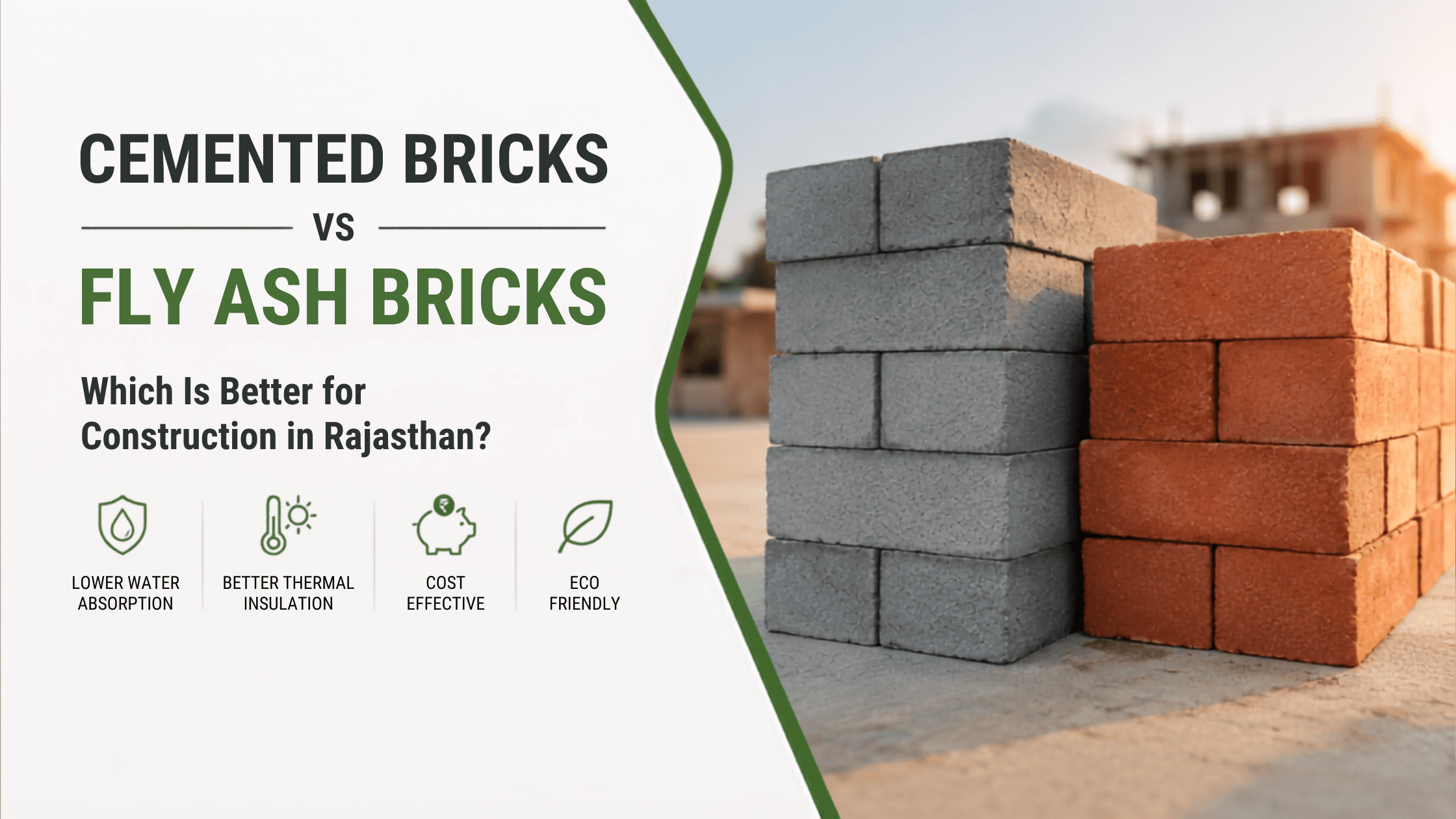
Fly ash bricks are the better choice for most construction in Rajasthan — they outperform cemented bricks on water absorption resistance, thermal insulation, eco-friendliness, and total project cost. In Udaipur and across Rajasthan’s hot-dry climate, fly ash bricks are the preferred choice for partition walls, exterior walls, residential builds, and cost-conscious commercial projects. Cemented bricks are recommended only for multi-storey load-bearing walls and foundations where peak compressive strength is the priority.
Builders and contractors sourcing from a fly ash bricks manufacturer in Udaipur face a genuine technical choice, not just a price comparison: fly ash bricks and cemented bricks perform differently on strength, water absorption, and long-term durability — and Rajasthan’s climate makes fly ash bricks the more practical solution for most applications.
Rajasthan’s combination of intense summer heat, low humidity, and occasional heavy monsoon bursts stresses building materials differently than more temperate climates — making water absorption and thermal performance genuinely decisive factors. These are exactly where fly ash bricks consistently outperform cemented bricks.
🧱 What Each Brick Type Actually Is
Cemented Bricks
Made from a cement, sand, and aggregate mix, cured under controlled conditions. Known for high compressive strength, primarily used in load-bearing and heavy structural applications.
Fly Ash Bricks
Manufactured using fly ash (a coal combustion by-product), lime, and gypsum. Lighter, more dimensionally precise, with lower water absorption, better thermal insulation, and a significantly smaller environmental footprint.
🏭 How Each Brick Type Is Actually Made
Cemented bricks are produced by mixing cement, sand, and aggregate in controlled proportions, then curing under conditions designed to maximise strength development — the quality of curing time and technique has a direct, measurable effect on final compressive strength, which is why sourcing from an established manufacturer matters more than raw material specification alone.
Fly ash bricks go through a fundamentally different process: fly ash, lime, and gypsum are mixed and either autoclaved or cured through a chemical reaction that binds the materials into a dense, uniform block. This process is what gives fly ash bricks their characteristic dimensional consistency — tighter tolerances than cemented bricks — which directly reduces plastering material required and improves mortar joint quality across the finished wall.
💪 Strength Comparison
Cemented bricks have a higher raw compressive strength — relevant for multi-storey load-bearing walls in large structures. However, fly ash bricks comfortably meet compressive strength requirements for the vast majority of residential and mid-rise commercial construction, and their superior dimensional uniformity often produces stronger, more consistent mortar joints — which is what actually determines wall strength in everyday building practice.
85%
74%
60%
82%
55%
78%
45%
88%
Fly Ash Bricks
💧 Water Absorption: The Key Advantage of Fly Ash Bricks in Rajasthan
Water absorption is where fly ash bricks demonstrate their most important performance edge in Rajasthan’s climate. Bricks that absorb more moisture during monsoon bursts are more prone to efflorescence (visible salt deposits) and gradual structural degradation over years of seasonal cycling. Fly ash bricks show measurably lower water absorption than cemented bricks — an 82% vs 60% resistance score — making them the more durable, lower-maintenance choice across Rajasthan’s sharp wet-dry climate cycles.
Udaipur and other Rajasthan cities experience sharp wet-dry seasonal cycling — monsoon humidity followed by extreme dry heat. This cycling is exactly what causes efflorescence and long-term brick degradation in higher-absorption materials. Fly ash bricks’ lower absorption rate directly addresses this risk.
🌡️ Thermal Performance: Why Fly Ash Bricks Suit Rajasthan’s Heat
Fly ash bricks offer significantly better thermal insulation than cemented bricks — a particularly valuable property in Rajasthan, where interior cooling costs run high for most of the year. Interiors built with fly ash bricks stay measurably cooler during peak summer months, reducing the long-term cooling load on the structure. Compounded across a building’s lifetime, this thermal advantage translates into real energy savings that purely strength-based comparisons overlook.
💰 Cost Per Unit: Why Fly Ash Bricks Win on Total Project Cost
Fly ash bricks consistently come out ahead on total project cost — not just headline per-brick price. Once transport savings (from lighter weight) and reduced plastering material (from more uniform dimensions) are factored in, the cost advantage is meaningful, particularly on larger residential and commercial builds in Udaipur and Rajasthan.
♻️ Eco-Friendliness: A Genuine Advantage, Not Just Marketing
Fly ash bricks repurpose a coal-combustion industrial by-product that would otherwise require costly disposal — giving them a verifiable, significant sustainability advantage over cemented bricks, which rely heavily on virgin cement production, itself a carbon-intensive process. For builders and project owners increasingly required to demonstrate environmental credentials on commercial builds, fly ash bricks offer a legitimate, documented point of differentiation backed by the material’s origin and manufacturing process.
Fly ash bricks score 88% on eco-friendliness vs 45% for cemented bricks — driven by industrial by-product reuse, lower cement content per unit, and a significantly reduced carbon footprint per brick manufactured. This is a real, verifiable differentiator for green building projects.
Raj Mineral manufactures quality-controlled fly ash bricks in Udaipur with consistent compressive strength, uniform dimensions, and tested water absorption rates — so the bricks you receive on site perform to their rated specifications every time, not just on a data sheet.
🏗️ Application-Specific Recommendations
| Application | Recommended Type | Reason |
|---|---|---|
| Residential partition walls | Fly Ash Bricks ✓ | Sufficient strength, better thermal comfort, lower total cost |
| Exterior walls, monsoon-exposed | Fly Ash Bricks ✓ | Lower water absorption prevents efflorescence and long-term degradation |
| Commercial builds with sustainability targets | Fly Ash Bricks ✓ | Verifiable eco-credentials — industrial by-product reuse documented |
| Mid-rise residential or commercial construction | Fly Ash Bricks ✓ | Meets structural requirements with added thermal and cost advantages |
| Multi-storey load-bearing walls | Cemented Bricks | Higher raw compressive strength required for heavy structural loads |
| Foundation and plinth work | Cemented Bricks | Higher strength suited to below-grade structural loads |
⚖️ Which Should You Choose?
For most construction in Rajasthan — residential, partition walls, exterior walls, and mid-rise commercial builds — fly ash bricks are the better-performing, more cost-effective, and more sustainable choice. The only applications where cemented bricks hold a clear advantage are multi-storey load-bearing walls and foundations, where peak compressive strength is genuinely non-negotiable. For everything else, fly ash bricks’ combination of lower water absorption, better thermal insulation, lower total project cost, and documented eco-credentials makes them the stronger all-round option for Udaipur and Rajasthan’s construction market.
Many experienced contractors in Udaipur and Rajasthan use fly ash bricks for partition walls, exterior walls, and non-structural sections — and cemented bricks only where structural loads genuinely demand it. This hybrid approach captures fly ash bricks’ cost, thermal, and sustainability advantages across the majority of the build, while preserving cemented bricks’ strength advantage in the limited sections that require it. Discuss this approach with your structural engineer before defaulting to a single material across the entire project.
✅ Buyer’s Checklist Before Ordering Fly Ash Bricks
- ✔Confirm compressive strength rating meets your structural requirement — most residential builds are well within fly ash brick specs
- ✔Ask for water absorption test data — fly ash bricks should measurably outperform standard cemented bricks here
- ✔Compare total project cost including transport and plastering savings — not just per-unit price
- ✔Verify dimensional accuracy across a sample batch — uniform fly ash bricks reduce plastering material and improve mortar joints
🏁 The Bottom Line
For most residential and commercial construction in Rajasthan, fly ash bricks are the smarter choice — lower absorption, better thermal insulation, lower total project cost, and a verifiable sustainability advantage. The one exception is heavy load-bearing structural work, where cemented bricks’ higher compressive strength is the deciding factor. What matters equally in both cases is sourcing from a quality-controlled manufacturer — because even the better material underperforms when production consistency is poor.
Need Fly Ash Bricks for Your Project in Rajasthan?
Raj Mineral supplies quality-controlled fly ash bricks in Udaipur with consistent dimensions and tested water absorption rates — get a quote for your specific project requirements.