

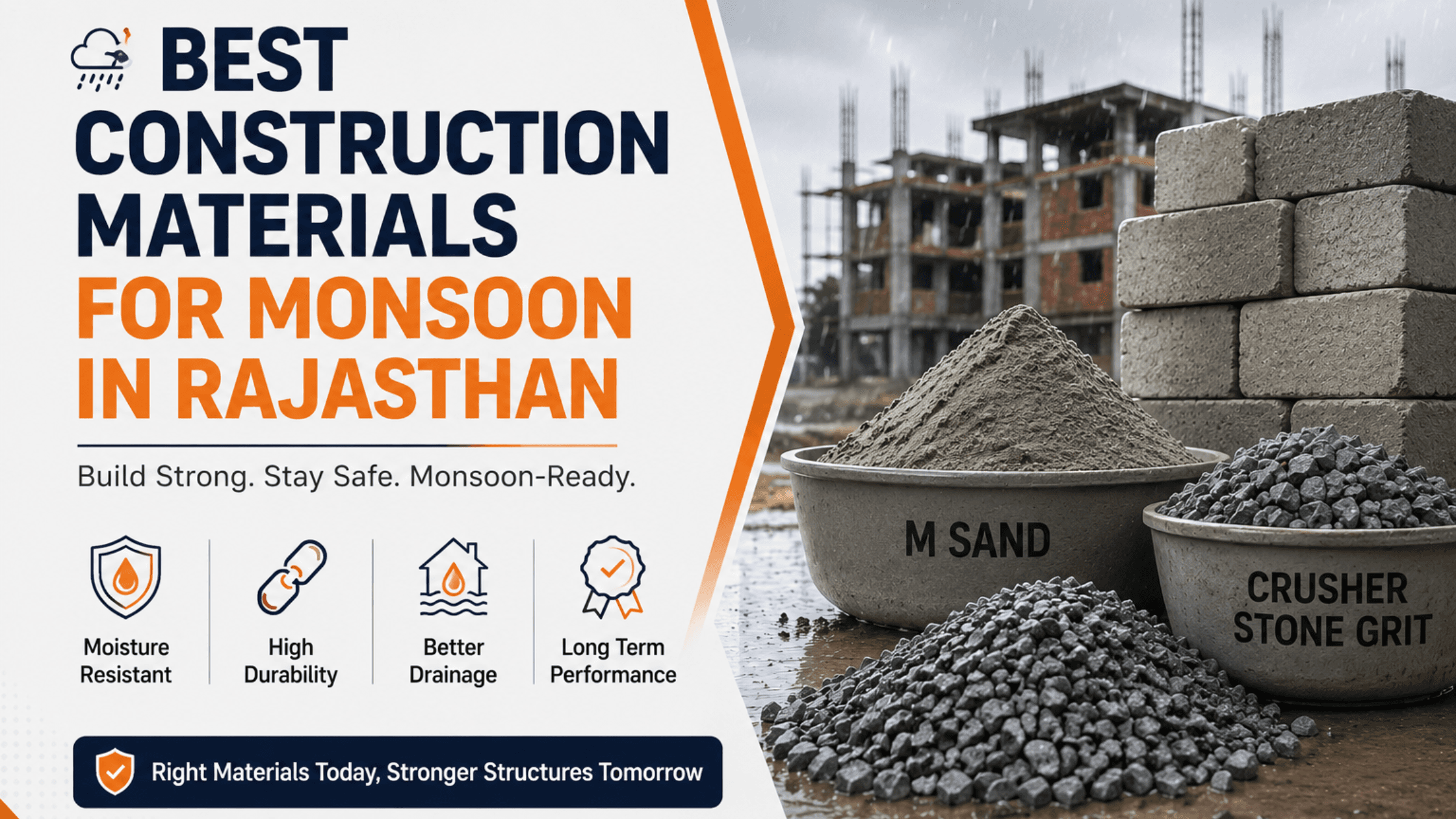
Fly ash bricks, M Sand (Manufactured Sand), and crusher stone grit are the three construction materials that hold up best during monsoon construction in Rajasthan. Each resists moisture, maintains structural integrity in wet conditions, and performs reliably through the June–September rain season.
📋 Table of Contents
- Why Material Choice Matters More During Monsoon
- Fly Ash Bricks: The Clear Winner for Walled Structures
- M Sand: Why Contaminated River Sand Is a Monsoon Risk
- Crusher Stone Grit: Essential for Drainage and Strength
- Interlocking Paver Blocks: Smart Choice for Outdoor Surfaces
- AI Takeaway: Material Cheat Sheet
- FAQs
Rajasthan gets a reputation as a dry desert state. But anyone who has managed a construction site in Udaipur, Bhilwara, or Kota during July knows — the monsoon here is no joke. Sudden heavy downpours, muddy sites, and humidity that stays well above 80% create a completely different working environment than the summer months.
And yet, thousands of homes and infrastructure projects go up every monsoon season. The difference between a project that stays on track and one that runs into structural trouble often comes down to one thing: material selection.
🌧️ Why Material Choice Matters More During Monsoon
Rain doesn’t destroy buildings — wrong materials do.
When moisture enters a structure through low-quality bricks, contaminated sand, or poorly graded aggregates, the damage is invisible at first. You’ll see it six months later — wall cracks, plaster peeling, floor settling. By then, the cost of fixing it is significantly higher than the cost of getting it right from day one.
⚠️ Note: According to a 2025 study on Indian infrastructure, material delays and poor site conditions are the leading causes of project cost overruns during monsoon months. Rajasthan’s construction sites face this pressure every single year.
🧱 Fly Ash Bricks: The Clear Winner for Walled Structures
If there’s one material that genuinely thrives in wet conditions, it’s fly ash bricks in Udaipur.
Standard red clay bricks absorb water readily. When moisture enters, bricks expand slightly, weaken the mortar bond, and contribute to wall seepage. Fly ash bricks behave differently — their water absorption rate stays well below 12%, which means rain doesn’t penetrate deeply into the wall.
Beyond water resistance, fly ash bricks offer:
- Higher compressive strength (3.5–7.5 MPa) compared to conventional clay bricks
- Thermal insulation — keeps interiors cooler even when humidity is high
- Uniform size — reduces mortar usage and speeds up construction in shorter dry windows between showers
- Lower efflorescence — white salt deposits that ruin wall surfaces are far less common with fly ash bricks
✅ Pro Tip: For Rajasthan’s monsoon conditions specifically, the combination of moisture resistance and thermal efficiency makes fly ash bricks the practical choice for both residential and commercial builds in Udaipur and surrounding districts.
🏗️ M Sand: Why Contaminated River Sand Is a Monsoon Risk
Here’s something most people don’t account for: sand quality changes during the monsoon.
River sand collected near riverbeds picks up silt, clay, and fine particles at a much higher rate when water levels rise. That contaminated sand — mixed into your mortar or concrete — directly weakens the bond strength. You won’t see it during casting. You’ll feel it when cracks appear after the first dry season.
M Sand (Manufactured Sand), produced by crushing hard granite under controlled conditions, has a consistent gradation that doesn’t change with rainfall or seasonal variation.
Key advantages of M Sand during monsoon construction:
- No silt content — manufactured under a controlled process, free from clay and organic impurities
- Better water-cement ratio control — consistent particle size means mortar behaves predictably even in humid conditions
- Improved mortar workability — critical when you have limited dry windows to lay bricks or cast slabs
- IS 2116 compliant — meets Bureau of Indian Standards specification for fine aggregate in masonry mortar
⚠️ Avoid river sand during monsoon months in Rajasthan carries a high silt risk. For any structural work — plastering, concrete casting, brickwork — M Sand for monsoon construction is the safer, more reliable choice.
🪨 Crusher Stone Grit: Essential for Drainage and Structural Strength
Waterlogging is one of the most common monsoon site problems in Rajasthan. Poor drainage doesn’t just slow down work — it weakens foundations, erodes sub-base layers, and causes settlement in pavements and flooring.
Crusher stone grit drainage plays a critical role in two areas during monsoon construction:
Angular-shaped crusher stone grit (6mm, 10mm, 20mm, 40mm grades) creates excellent void spaces that allow water to drain away from foundations and floor beds. Unlike rounded river gravel, the angular shape locks together while still permitting drainage flow.
Crushed stone grit in 20mm and 10mm grades is the primary coarse aggregate in structural concrete. A crushing value below 30% (tested under IS 2386 Part IV) ensures aggregate doesn’t break down under load — keeping your pours strong even in wet curing conditions.
✅ Remember: If your foundation sub-base is weak or poorly draining, no amount of surface waterproofing will save your structure from long-term settlement. Get the sub-base right first.
🟥 Interlocking Paver Blocks: The Smart Choice for Outdoor Surfaces
Driveways, pathways, parking areas, and boundary approaches all take a beating during monsoon. Poured concrete surfaces crack when water seeps into hairline gaps and expands. Traditional flooring options require long curing periods that are difficult to maintain during rain.
Interlocking paver blocks sidestep most of these problems:
- No mortar joints — water drains between blocks rather than sitting on the surface
- Individual replacement — if a block shifts or cracks, you replace one unit, not the entire slab
- Permeable base design — when laid on a properly compacted crusher stone sub-base, paver blocks help manage surface water runoff
- Immediate load-bearing — no curing wait time means you can resume site access faster after laying
For Rajasthan homes where the front approach, parking, and garden paths all need to function through four months of monsoon, paver blocks in rainy season offer a durability advantage that poured concrete simply can’t match.
Monsoon Construction in Rajasthan — Material Cheat Sheet
❓ Frequently Asked Questions
Q1. Can construction continue normally during Rajasthan’s monsoon season?
Yes, construction can continue during monsoon in Rajasthan with the right material choices and site management. Structural work like brick laying, concrete casting, and foundation work can progress during dry intervals. The key is using moisture-resistant materials like fly ash bricks and M Sand, maintaining proper site drainage, and storing materials on raised platforms under covered sheds to prevent moisture damage.
Q2. Why is M Sand better than river sand for monsoon construction?
M Sand is better during monsoon because its quality stays consistent regardless of season. River sand collected during monsoon months often contains elevated silt and clay from flooded riverbeds, which weakens mortar bonding strength. M Sand is manufactured under controlled conditions with zero silt content, giving your mortar and concrete a reliable, predictable performance even in high-humidity conditions across Rajasthan.
Q3. Which brick type is best for construction during heavy rains in Rajasthan?
Fly ash bricks are the best choice for monsoon construction in Rajasthan. Their water absorption rate stays below 12%, significantly lower than standard clay bricks. This means walls stay dry, mortar bonds remain intact, and the risk of seepage and wall cracks after the rainy season drops considerably. Fly ash bricks also offer better thermal insulation, which helps manage indoor humidity in Udaipur and Rajasthan’s climate.
Q4. What role does crushed stone grit play in monsoon construction?
Crusher stone grit in Rajasthan serves two critical monsoon roles: drainage and concrete strength. Angular-shaped stone grit creates natural drainage pathways in sub-base layers, preventing waterlogging under floors and foundations. As a concrete aggregate, tested stone grit with a crushing value below 30% ensures your structural pours maintain full strength even in wet curing conditions throughout the monsoon months.
Q5. Are interlocking paver blocks suitable for outdoor areas during monsoon?
Yes, interlocking paver blocks are one of the best outdoor surface solutions for monsoon conditions in Rajasthan. Unlike poured concrete, they don’t require long curing periods and allow rainwater to drain between block joints rather than pooling on the surface. When laid over a compacted crusher stone sub-base, they remain stable and load-bearing even through heavy monsoon rainfall across Udaipur and Rajasthan.
📌 Key Takeaways
- ✓ Material quality during the monsoon directly determines whether your structure holds for decades
- ✓ Fly ash bricks outperform red clay bricks in water absorption and strength under rain
- ✓ M Sand eliminates monsoon silt risk and gives consistent mortar performance
- ✓ Crusher stone grit is critical for sub-base drainage and concrete mix quality
- ✓ Paver blocks are the smartest outdoor surface choice for monsoon conditions in Rajasthan
- ✓ Monsoon builds can cost 12% more — the right material choice is the best cost-saving strategy
Building in Rajasthan This Monsoon?
Get Lab-Tested, Monsoon-Ready Construction Materials
M Sand · Crusher Stone Grit · Fly Ash Bricks ·— all tested to IS standards and supplied across Udaipur & Rajasthan.